
This is a revised version of a blog post that appeared on the UC Davis ModLab website in late 2024.

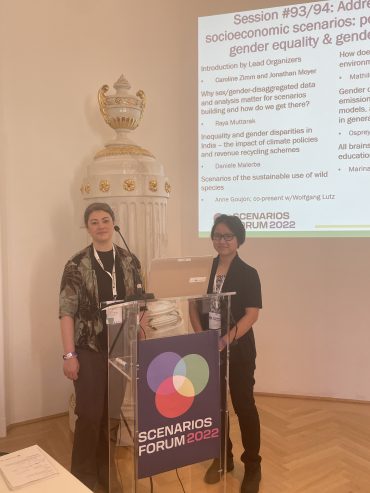
In 2022, a team organized by ModLab Project Director Harlin/Hayley Steele and helmed by community partner Osprey Orielle Lake, who is Executive Director of Women’s Earth and Climate Action Network (WECAN) International, offered a presentation at Scenarios Forum, a leading gathering of an IPCC-affiliated climate modeling community. This presentation helped influence the addition of gender equity metrics in the “next generation” of a leading climate modeling framework that is in the process of being finalized for the AR7 that will take place in 2028.
In their presentation, the ModLab-affiliated team advocated for the inclusion of new metrics in climate modeling frameworks to reflect research that shows improved gender equity has a measurable impact upon emissions. Essentially, as they argue, when gender equity goes up, emissions go down.
The team’s presentation, which can be viewed below, was featured as part of a panel at Scenarios Forum 2022, a leading gathering of IPCC-affiliated climate modelers.
Here is a video of the presentation:
The team’s deeply interdisciplinary research for this presentation blends direct engagement with climate modeling frameworks with methods from the humanities. They drew upon work from the field of media studies, especially the work of Dr. Katherine Buse, ModLab alum, who treats climate models a form of media. They also drew upon work from the field of Critical Code Studies, an approach that “applies critical hermeneutics to the interpretation of computer code, program architecture, and documentation within a socio-historical context” (Marino 2006). The team also utilized reparative data practices found in the social sciences (see: Currie et al 2016) that can be traced back to the work of the Centre for Cultural Studies in the 1970s (see: Ch 3, Hall et al. 1978).
From making science games to hacking leading climate models
This work emerged from an earlier ModLab project Steele directed to develop climate science curricula that would be formatted as game-making activities. This project was supervised by Colin Milburn, who has written on the relationship between games and society, and was inspired by 2016 research conducted at ModLab by Dr. Joseph Dumit, who argues that having students design games about about topics improves comprehension. Steele was also inspired by conversations with youth climate organizers they worked with in 2019 who voiced the need for educational tools to help make climate data more comprehensible.
As part of this first ModLab project, Steele’s team developed a number of interactive media pieces that integrate climate data as part of game-making-based educational activities.
The pieces they developed included Destination Wedding 2070 (DW70), a wedding planning simulator set 50 years in the future in which “climate change is the ultimate wedding crasher”—a project in which game organizers must work with IPCC-affiliated climate assessment tools to establish the conditions in which the future wedding will take place. For the 2019 run of the piece, Steele’s team choose to use data from simulations of Earth from the CanESM5 model running the conditions laid out in SSP585.
Another interactive piece that emerged through the work of Steele’s team was Sivad, a roleplaying rule system in which character “stats” are linked to real world ecological data—”If real world ecological tipping points are crossed, a character you love will take damage!” This piece drew upon a design methodology called “paraludic points systems” that Steele first laid out as part of the 2016 Living Games Conference. In this approach, games are designed in such a way that real world indicators trigger diegetic or “in-game” events.
“In the case of Sivad, I was using the Mauna Loa C02 numbers to calibrate the health bar for a major non-player character (NPC) in the game,” Steele explains. “But this process was starting to fall apart because of baseline issues we were having with the SSPs, a leading ‘meta-framework’ used to calibrate climate models. The trouble we were finding was that when we tried to integrate the SSPs into our overall process, our deeply holistic hands-on climate data curricula would start to break down. Rather than complaining, we decided to draw upon the “hacker ethos” and joined the communities that work on the scenarios to see if we could get the processes into motion to repair the baseline issues we’d identified. This led to the launch of a totally new ModLab project, but one that emerged from and couldn’t have happened without the first project. The first task we decided to tackle in this new project was to address some data gaps we had identified in the SSPs. These data gaps were the result of new studies that had been published in peer-reviewed publications after the SSP development process had concluded. These studies indicate that that, statistically, when systemic oppression increases, emissions go up.”
The team found a number of studies and data sets that support the conclusion that improved gender equity, anti-racism, and enhanced Indigenous rights reduce emissions.
As Steele explains:
“These studies reinforce what activists have been saying for years: That the same social processes that lead humans to dehumanize and exploit other groups of humans drive the processes that lead to anthropogenic degradation of Earth systems.”
Joining an IPCC-Affiliated Research Community
The ModLab team worked with community partners to develop a presentation that aimed to ensure the new studies they found would be considered by the researchers who specialize in the development of ‘scenarios.’ In the context of modeling climate, scenarios might be thought of as ‘meta-frameworks’ that are used by scientists to calibrate their models.
The team was thrilled when they learned their presentation had been accepted to be included in a session at Scenarios Forum 2022, a leading gathering of the climate scenarios community.
At Scenarios Forum, the team spoke alongside other researchers from global institutions exploring the possibility of including the impact of gender-based oppressions in climate scenarios and models. The work of the team was synthesized with others on their panel in the Scenarios Forum 2022 Meeting Report, which pays special attention to information and conclusions that the ModLab-affiliated team brought to the session.

The team’s contribution at the meeting was weighed as part of a deliberative process organized by the Institute for International Systems Analysis (IIASA) over the next 15 months.

“For many months, we weren’t sure if we’d had an impact,” Steele explains. “Others in the scenarios community were deliberating what we had presented, and were conducting their own investigations into the available data and studies.”
Flash forward to Leap Day 2024:
On February 29th, 2024, a new prototype was released of “the next generation” of the SSPs, a leading scenarios framework. This prototype is called the SSP Extensions Explorer.
The team was excited to see that in it, there are new variables that treat gender inequity is a driver of CO2 emissions.

This prototype is in process to be incorporated various other modeling frameworks over the next few years. The inclusion of these variables is a step towards better integration of data that show gender inequity as a driver of emissions.
A team effort
Joining Steele and Lake in creating the 2022 presentation, this team included ModLab Undergraduate Researcher Alisha Chan, WECAN Communications Director Katherine Quaid, and ModLab affiliate Dawn Dietrich, who teaches Cultural Studies and English at Western Washington University.
Steele emphasizes that while the team was guided by research methods in the humanities and social sciences, they were also drawing upon the data and findings of other researchers.
“Doing this kind of research is more of a relay race than a marathon. Sometimes the people who do the research that supports the inclusion of variables don’t quite have the right skills to make sure their data are considered for inclusion in the models, or in this case, the scenarios. This project really speaks to the need to have more humanities researchers as part of scenarios communities, especially those working at the intersection of critical code studies and critical data studies. We hone particular skillsets that make it easier for us to identify when things are being left out.”

Gender representation in leadership: A key to combatting climate change
“When better gender representation can be found in decision-making bodies, especially in company boards and in higher office, this drives the passage of stronger environmental policies.” Steele explains. “That’s where this gender-equity-based emissions reduction comes from.”
Steele brings up a study published in Sustainable Development that found when a country had a 1-point increase on the Women’s Political Empowerment Index (W-PEI), that country on average has an 11.51% drop in CO2 emissions over time, even when controlling for other factors.
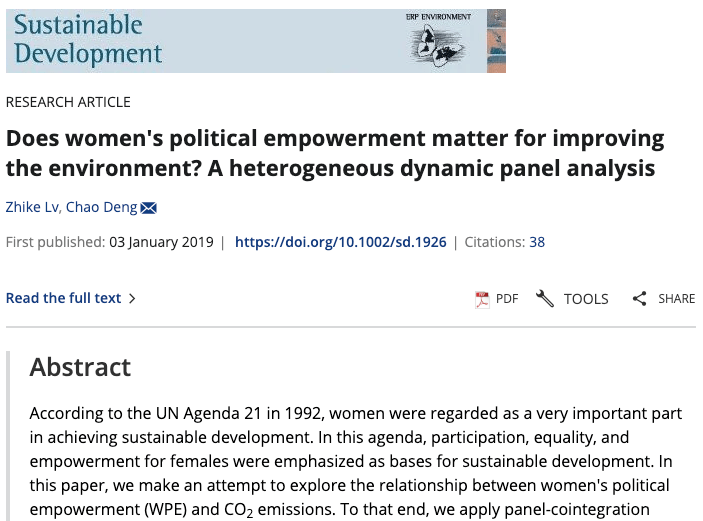
“And the thing about the W-PEI,” Steele says, “Is it’s not just a measurement of gender representation in leadership. It also looks at other factors, like the presence of women in journalism, the ability of women to travel, to take part in civil society.”
“What this means is that it simply isn’t a matter of cramming women onto boards,” Steele says. “What these findings show is that that there needs to be gender equity across every level of society if you want to see this kind of emissions impact. This is something that needs to be holistic and systemic.”
When asked if this means women should run everything, Steele refutes the idea. “None of the data we looked at says that there should be only women leaders,” Steele says. “Rather, there seems to be a need for balance. This gets us into research on group decision-making conducted by psychologists. We get into this more in another talk regarding evidence on racial equity and emissions reductions we gave at the gathering. People just tend to make better decisions when there’s a good mix of people of different backgrounds at the table with an equal say in what’s decided.”
Debunking myths: The gender-based emissions drop has nothing to do with birth rates
Steele has been surprised by the “knee jerk” reactions from people when they first hear that improved gender equity reduces emissions. “People tend make up reasons for why this is the case based upon biased assumptions,” Steele explains. “And sometimes the reasons they come up with are dangerously wrong.”
According to Steele, a common reaction when people learn that gender equity reduces emissions is that it has something to do with birth rates.
“This is demonstrably false.” Steele says. “The idea that the amount of people causes pollution is a myth—and spreading this myth hinders efforts to regulate polluters.”

Regarding the myth of “overpopulation,” Steele points to the work of ModLab researcher and historian of demography Emily Klancher Merchant. In Merchant’s award-winning book of history, Building the Population Bomb (Oxford University Press, 2021) Merchant explores how fossil fuel interests bankrolled a massive mid-20th century misinformation campaign that led world leaders, scientists, and the public to falsely believe that population numbers somehow drive all kinds of pollution. Merchant has called this work by fossil fuel interests to deflect blame for pollution onto human population numbers “an accounting trick.”
As Merchant’s work details, there is no scientific backing to the idea that reducing the number of people on the planet will have any impact upon pollution, yet the myth persists to this day.
A number of social scientists, including Dr. Jade Sasser at UC Riverside, have found that the concept of ‘people-as-emissions’ sows contention in climate decision-making spaces and this forestalls environmental regulation.
“The myth of people-as-emissions isn’t just wrong,” Steele explains, “but it delays our ability to address climate change.”
A matter of semantics: Gender “equality” verses “equity“
While Steele and the team are excited to see gender included as a variable in the new SSP extensions, Steele expresses that they would have preferred that the term “gender equity” rather than “gender equality” to have been used.
“The two terms have very different meanings,” ” Steele explains, “and the term ‘equity’ gets closer to the social processes we are actually looking at here. I mean, the genders are already equal. It’s just systemic factors that skew things, and that’s what’s meant by ‘inequity.'”
Steele still sees the changes as a hopeful advancement. “It means the emissions impact of gender equity has a better chance of making it into future climate policy discussions, and that could be a game changer in steering the planet towards the best climate outcome that’s still possible.”
Further research underway
Steele has continued their involvement with the scenarios community, and is in the process of organizing further projects that center interventions into leading climate modeling frameworks. In 2024, Steele joined the Feminist Research Institute, and began directing a project to develop a new modeling paradigm, BasedMIP, which Steele hopes to eventually launch as an IAM.
Media Coverage:
Common Dreams. “Women’s Group Highlights Gender Equity as a Significant Driver of CO2 Emissions Reduction During Forum on IPCC Climate Modeling” by Katherine Quaid (June 20th, 2022)
UC Davis Climate Blog. “Gender Equity Reduces CO2 Emissions” by Hayley Morris (August 16, 2022)
Suggested citation for the team’s presentation:
Lake, Osprey Orielle, Katherine Quaid, Harlin/Hayley Steele, Alisha Chan, and Dawn Dietrich. “Gender diversity in leadership reduces emissions. What does this mean for our models, and for climate communications in general?” Presented at Scenarios Forum 2022. IIASA Headquarters, Laxemburg, Austria. 20-22 June 2022. Recording at: youtu.be/EiYUWRlhpic


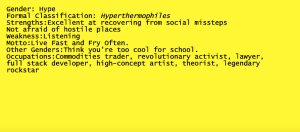


 Harlin/Hayley Steele
You must be logged in to post a comment.